Science, Technology, and Public Health
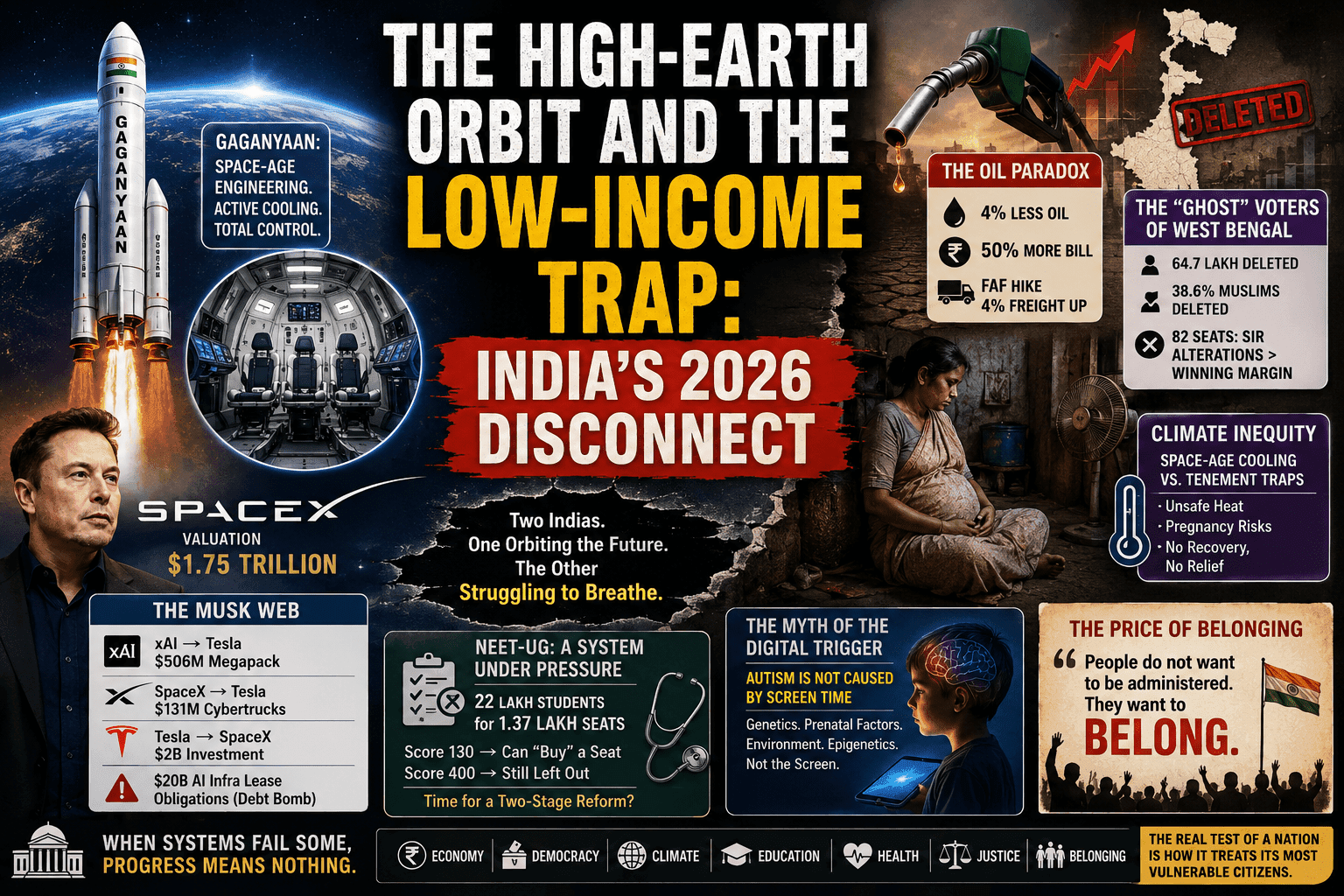
Gaganyaan: Life
Support in Orbit (ECLSS)
Gaganyaan’s ECLSS must manage the risk of hypercapnia (CO2 poisoning)
caused by the 1 kg of CO2 exhaled by an adult daily.
- Parameters: Pressure is maintained
at 101.3 kPa with temperatures at 20-26°C.
- Waste/Fire: Suction-based airflow
manages "floating globules" of waste. For fire suppression,
water mists are used; notably, the Soyuz module retains a
depressurization option as a last resort, a riskier alternative to India's
mist system.
Public Health: The
Heat Stress Crisis
A 2024 BJOG study highlights that 74% of Tamil Nadu’s population
is exposed to temperatures above 35°C. For pregnant women in Chennai’s
tenements, this leads to preterm birth and intrauterine growth restriction.
Live Test Series
Join thousands of aspirants in our weekly live mock tests. Get real-time ranking and detailed analysis.
- Policy Failure: The TNUHDB has
acknowledged that previous housing designs prioritized "cost over
lived experience," creating concrete heat traps. The NDMA 2025
advisory now mandates climate-resilient "cool roofs."
The
Neurodevelopmental Debate: Autism
Dr. Shefali Gulati (AIIMS) clarifies that while screen time is an
environmental factor, it is not a sole cause of ASD. Children with ASD may
naturally "prefer" screens due to their predictable nature. The focus
remains on the "First Thousand Days" of life for critical
neural network formation.
Education: The
NEET-UG Systemic Crisis
The 2026 NEET-UG controversy, involving 22 lakh aspirants competing for only
1.37 lakh seats, has exposed "deep cracks" in the centralized system.
The K. Radhakrishnan Committee recommends a two-stage examination
and limiting attempts to reduce the "high-stakes" desperation that
fuels paper leaks.